
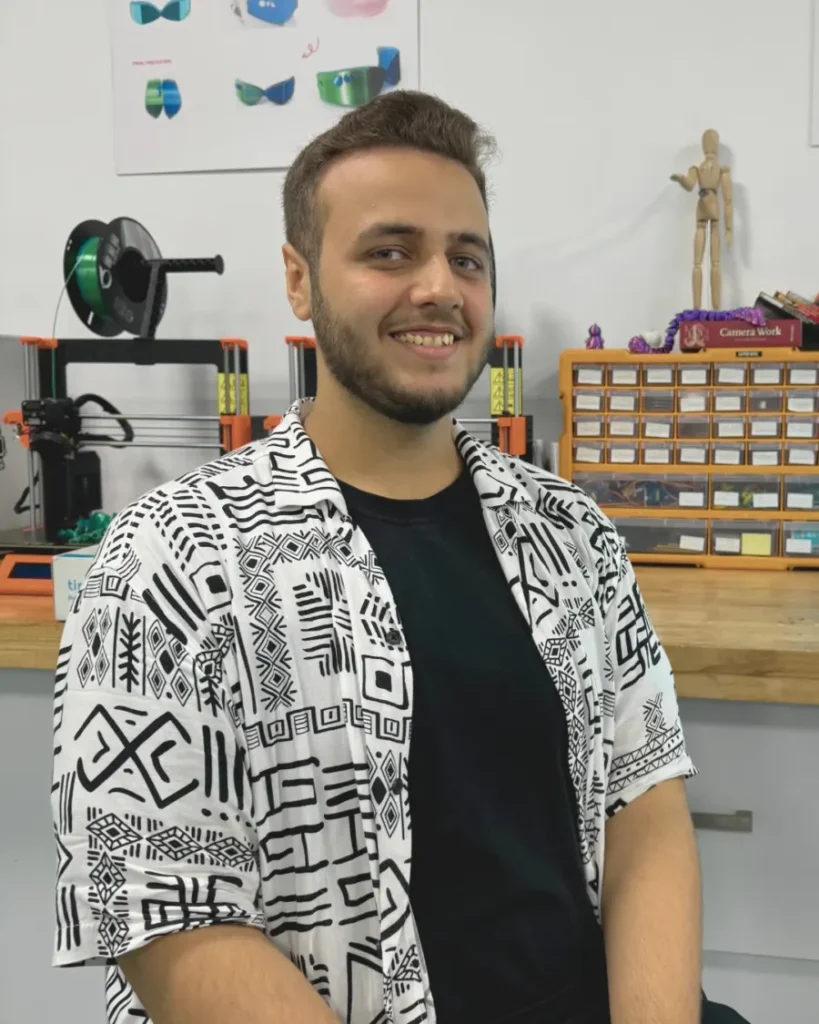
Mohamad Hadaya, a Karam young leader

Mohamad Hadaya

From Trauma to Triumph

When Mohamed was just 16, walking to a class he was taking in his small town, a group of boys approached him and pushed Mohamad to reveal where he was from. Innocently and proudly, he said he was from Syria, but the answer resulted in a brutal attack. The gang of boys surrounded him, ripped his headphones off, and began beating him mercilessly. Punches to his face, kicks to his back, stomps onto his chest— he was outnumbered and caught off guard. In broad daylight, people passed by, and no one stepped in to help.

He finally managed to stumble away and escape, but the attackers pulled him back in again. A series of more punches and kicks followed until a fellow Syrian on a motorcycle intervened and pulled him away. Shocked and confused, Mohamed somehow still continued on his way to get to his class. It wasn’t until his teacher saw him beaten and shaken that the reality of what had happened settled in. The teacher called his father, who then went to the police station to file a report. However, unable to speak Turkish properly, his father was mocked by the officers. Mohamed stood there, feeling powerless, as he watched his father struggle with the officers. Even now, three years later, there’s been no word from the police about his case.

The trauma of that attack stayed with Mohamed. He avoided the route where it happened, changing his walking path to school. He realized he developed a fear of being alone in public. The scars of the attack, both physical and emotional, ran deep.

Then, in 2023, Mohamed found something that changed his life forever. He learned about Karam House, and it was there that he found a place not just to learn but to heal. The moment he stepped into the space, the atmosphere felt different. It was inviting, it was alive, and most importantly, it was safe.

Karam House became a sanctuary for Mohamed. Here, he wasn’t a burden or an outsider. He was a creator, a learner, and part of a community. In studios, he discovered passions that reignited his love for learning, like music and robotics. One of his favorite experiences was building a simulated robot explorer designed for exploration. The project filled him with excitement and pride.

Karam House didn’t just teach Mohamed technical skills; it taught him resilience. He learned how to overcome setbacks and how to value the journey just as much as the destination. Mentors at Karam House helped him find direction and purpose, and they became the support system he so desperately needed.

With time, things in Mohamed’s life started to get better. While the racism towards him didn’t quite disappear, he learned to navigate it, realizing that attacks weren’t as easy for others to carry out against him now that he was older and wiser.

Now, as a university student studying computer engineering, Mohamed looks to the future with optimism, and the lessons he learned at Karam House continue to guide him. Though the wounds of the past still linger, the hope he found at Karam House gives him strength to keep going.
More stories

Musa Zeydan, a Karam young leader

Musa Zeydan

Follow your goals without any distractions

During Ramadan of 2012, Musa and his family packed their belongings and fled their small village in Idlib in search of a safer place. At that point, they were one of the last families to leave.

During Ramadan of 2012, Musa and his family packed their belongings and fled their small village in Idlib in search of a safer place. At that point, they were one of the last families to leave.

As a seven-year-old with little control over his destiny, Musa certainly couldn’t fulfill his dream to conquer the world around him. Thus, when he arrived in Reyhanli, Turkey, he made a compromise and decided to conquer the coding world. His curiosity in coding was born from video games on his computer and a desire to know what was going on behind the screen. Desire turned into action, and he started searching for free online sources to learn more.

When Musa turned fourteen, he joined Karam House where his older sister had already been taking Innovative Education studios. In addition to the required studios, Musa could pick studios of interest, and of course, Code Jam was his number one choice.

His passion for coding did not stop at Karam House. Musa reached out to an instructor he had heard about, Mr. Mansour, who teaches online coding classes. He presented his case — that he is a high school student with a huge interest in coding who can’t afford classes — and asked if he could take them for free. And even though Mr. Mansour had just announced that he wasn’t able to take on any more free students, he agreed.

After finishing all four Code Jam studios at Karam House, Musa asked his mentor if he could create his own Karam coding group. The answer was yes, and Musa began to recruit his friends. Musa is very determined, so it did not take much to invite and convince his friends to join. While they began as a group, the school workload caused many students to leave the group, which is now a team of five.

Musa is still learning different coding languages, and one way he’s putting his knowledge to use is by creating apps. The one he’s most proud of is his Karam project called Gym Coach: “The project is a Windows program designed by Visual Studio 2019 (GUI) and fully programmed using the C++ programming language (CLR). It is a sports program that helps trainers to allocate lessons and exercises to clients in an organized manner and allows them to monitor progress smoothly. It also has some auxiliary features such as a music player and BMI calculation which will help the trainer determine the appropriate exercises.”

This year, Musa created a new system for borrowing books from Karam House library. The system consists of two parts; one part is an app that the student at Karam House can download to their phones to look up books and find titles they want to borrow. The other part is the admin’s app, which is downloaded onto the library admin’s device to manage the books borrowed.

Musa came up with the idea to make borrowing easier for both students and supervisors. “This way borrowing is more enjoyable. This system is better than the previous borrowing system which utilized Google Sheets.”

Mohamad, Musa’s mentor, said that when someone asks him about Musa, one thing comes to mind: “Success usually comes to those who are too busy to be looking for it.” He said Musa is one of the top students in the studio, but he doesn’t show it. He is always eager to help his friends who are struggling without making them feel that he’s better or smarter than them.

When asked to give one piece of advice to someone his age, Musa said, “Follow your goals without any distractions. And always make use of your time, especially when quarantining at home.”

Mohamad Hasan, a Karam young leader

Mohamad Hasan

Opening Doors

When I was seven years old, my father was killed in an airstrike. I still remember the moment we heard the news—how my world changed forever. My father’s death forced me to grow up quickly. As the eldest, I became responsible for my family. We stayed in our home in Raqqa, Syria, even as the bombings intensified, holding onto hope that things would get better. Eventually, however, the destruction became too much, and we had no choice but to leave everything behind.

When I was seven years old, my father was killed in an airstrike. I still remember the moment we heard the news—how my world changed forever. My father’s death forced me to grow up quickly. As the eldest, I became responsible for my family. We stayed in our home in Raqqa, Syria, even as the bombings intensified, holding onto hope that things would get better. Eventually, however, the destruction became too much, and we had no choice but to leave everything behind.

For three years, we moved from place to place inside Syria—from Raqqa to Deir ez-Zor, and finally to my mother’s village in rural Aleppo. Life was uncertain, and every day was a struggle. In 2021, my uncle in Turkiye suggested that we flee Syria altogether. My mother was reluctant; she didn’t want to leave her family behind. But we knew we needed safety and a future, so we made the difficult journey to Turkiye.

Starting over in Turkiye was harder than I imagined. We lived in a shelter for orphans where the rules were strict, and freedom felt like a distant memory. I couldn’t work, and I had to start my education from scratch because my school certificates from Syria weren’t recognized. It felt like I had lost everything—my home, my father, and even my sense of self.

But then, I found Karam House.

When I first heard about Karam House, I didn’t know what to expect. Friends told me it was a place where you could learn and work on projects, but I never imagined how transformative it would be. From the moment I walked in, I felt something I hadn’t felt in years: hope. Karam House wasn’t just a place to study; it was a place where I could dream again.

One of the studios that impacted me the most was “Emotive Gateways.” It was here that I worked on a project called Emotional Mechanism Doors, which became one of my favorite accomplishments. In this project, I designed doors that moved to represent different emotions like trust, attraction, or indifference. To bring these feelings to life, I carefully chose mechanisms like circular gears, linear gears, and half-circle gears to control the movement of the doors. Each design was crafted using Rhino software, through which I meticulously planned the motion to reflect the emotions I wanted to portray. After finalizing the design, the pieces were laser-cut, and I assembled the doors to create a tangible representation of these emotions. It was a deeply creative and technical process, and seeing the finished product gave me a sense of pride and fulfillment I hadn’t experienced before.

The workshops, the mentors, and the friends I made at Karam House helped me rebuild my confidence. I discovered skills I didn’t know I had—like designing apps, working with technology, and translating emotions into innovative designs. Every project I completed reminded me that I still had a future and that I could still create something meaningful.

Now, as I look ahead, my dreams are clearer. Education is my priority. My mother always says we’d rather go hungry than give up on learning. I want to continue growing, not just for myself but for my family. I want to be an example for my younger siblings and a source of pride for my mother.

Karam House gave me a second chance at believing and dreaming. Next year will be my last year in high school, and I plan to continue my education and go to college.

Karam House is a sanctuary, a place where young people like me can find their voice, their purpose, and their strength. I will always carry these lessons I learned here when I return to rebuild Syria. I belong to Syria and dream of returning when things are stable.