Hanin Tlas, a Karam young leader

Hanin Tlas

I wore those shoes on my journey to keep my father close

My name is Hanin Tlas, and at 16 years old, I can proudly say that I’ve come a long way from the challenges life threw at me. Two years ago, I found myself in Dar El Ehsan, an orphanage that became my new home. But my journey began before that, in Homs, Syria.

I was just a five-year-old girl when my family and I left our hometown, escaping the harsh realities of war. It was a tough departure. We left immediately after my father was killed. But right before that, he gifted me new shoes for my birthday. I wore those shoes on my journey to keep my father close.

On the day of our departure, the weather was frigid, and it was snowing. I was scared and kept holding onto my mother’s hand. Right before we crossed the border, the man leading us started screaming to run, not look back, and never stop. I started running as fast as my little feet could take me; the snow was making it more challenging.

As I was focusing on not losing my mother’s hand, I suddenly felt my foot sinking. My shoe got stuck in the snow; I wiggled it fast, but the shoelaces loosened, and my shoe was left behind. I pulled my mother’s hand, screaming, “Wait, wait, my shoe got stuck!” She looked at me in a way I’d never seen before and said sternly, “There is no time.” As she dragged me for the rest of the way, I kept looking back, longing for a home, a father, and a shoe.

We finally crossed the border to a safe area where we could catch our breath. I looked down at my feet and saw that part of me was left on the Syrian side, and now part of me was going on this new adventure across the border in Turkiye.

I kept that shoe all those years wrapped and carefully tucked away in my closet. This shoe is a constant reminder of the sacrifices we made. And I am happy I left a print in the place I will always call home.

In our search for stability, we spent two years in Gaziantep, a year in Antakya, and another two in Reyhanli. The orphanage became our temporary refuge, yet my two older brothers couldn’t stay there. Instead, they found shelter with our uncle.

As time passed, my brothers embarked on a perilous journey, taking a dinghy to Germany. Though my mother wasn’t thrilled about their decision, their determination to forge a better future prevailed.

Eventually, life led us to Dar El Ehsan, where we were given an apartment, a stipend, and access to education. I found myself in the 10th grade, aspiring to teach English in the future, thanks to my passion for English literature.

My introduction to Karam House came through a friend, a fellow student, who opened the doors to a world of possibilities in 2022. Genius Camp became a space where I not only discovered Karam House but also found the freedom to express my thoughts openly.

I enrolled in the English Literature program with the goal of becoming an English teacher. I didn’t expect the transformative impact Karam House would have on my personality. With the guidance of my mentor, Ola, I shed my shyness and introversion, becoming more sociable and confident.

My favorite studio, “Threshold Spaces,” with Mohamad Hidan and Nour, became a hub where I learned to socialize, share my opinions confidently, and embrace my newfound community. Karam House is more than a place; it’s a catalyst for confidence, skill-building, and social growth.

Not only did I learn Turkish, but I am now attending Imam Khatib School. Reflecting on my journey, I can’t help but express my gratitude: “Thank you, Karam, for everything. You’ve been in my life for a short time, but your impact has been huge.”

Before Karam House, I had no friends, but now, the number is limitless. I discovered a passion for drawing and playing guitar, enriching my life with newfound interests and connections. Like many others at Karam House, my story is a testament to resilience, growth, and the transformative power of education and community. None of it would’ve been possible without the support of everyone, starting with donors to mentors, staff members, and even other students. Thank you for believing in us.
More stories

Wael Ajlouni, a Karam young leader

Wael Ajlouni

Do not hide your creativity: Draw, Write, Search

In an effort to fit into the new society that they now must call home, many refugees take extra steps to prove themselves to the natives of the adopted country. They start by mastering the language, engaging with the community, and focus on giving back.

In an effort to fit into the new society that they now must call home, many refugees take extra steps to prove themselves to the natives of the adopted country. They start by mastering the language, engaging with the community, and focus on giving back.

Wael Ajlouni left his hometown in Damascus and came to Istanbul, Turkey, with a goal in mind to improve himself and give back to the place that welcomed him and his family.

With difficulties making connections and not knowing many people, Wael found it hard to engage, until he learned about and joined Karam. Immediately after joining the studios, Wael’s creativity and love for his community was evident in his work.

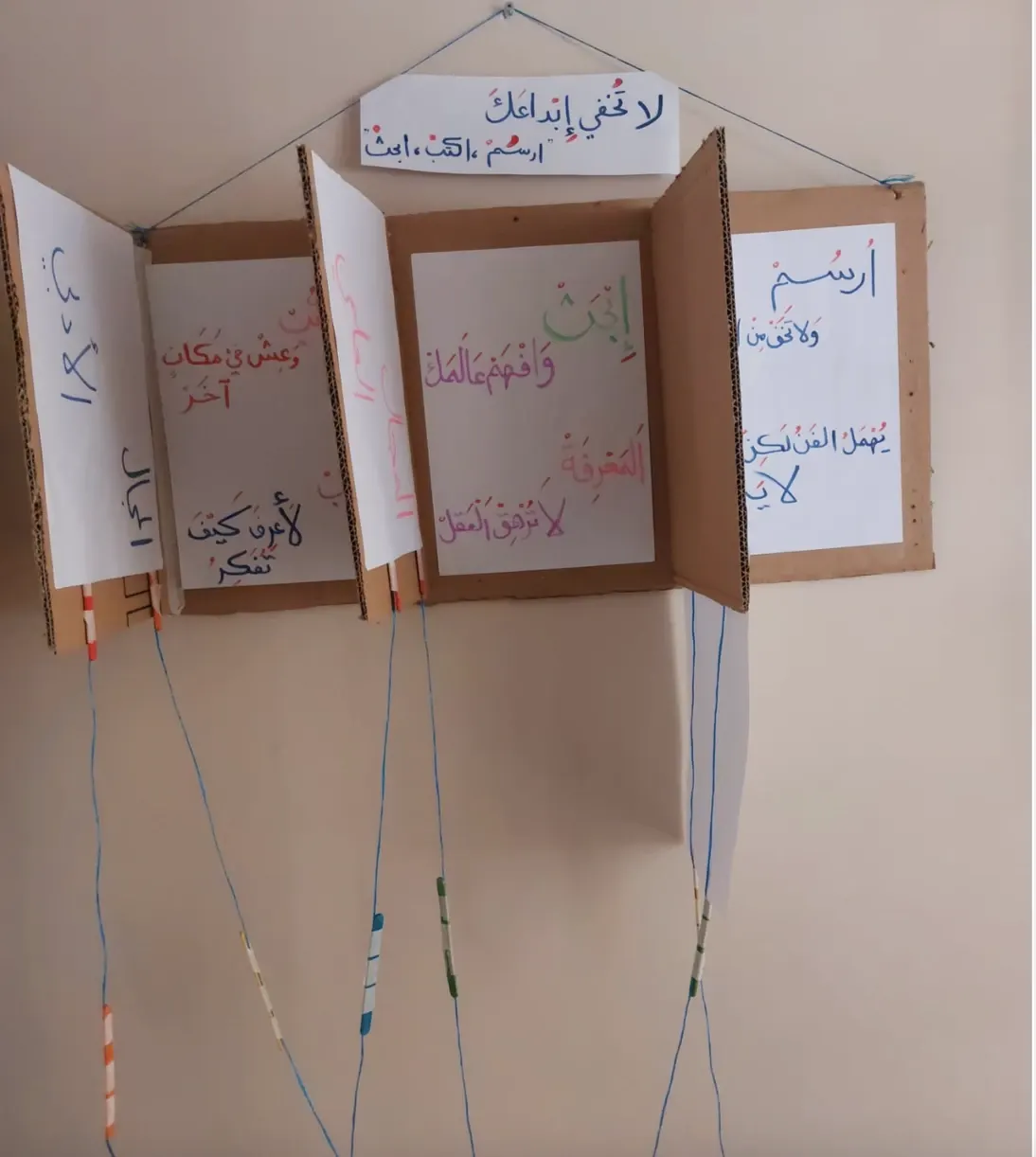
In a studio, Reimagining The Classroom, the students—including Wael— were asked to design and fabricate interactive objects that provide new ways of school-based communication, especially after going virtual and being entirely online . These ways should be designed to help students and teachers understand one another and effectively act according to each problem they face in a fun and innovative way.

In his description of his own project, Performance Management, Wael said: “Each child is talented in their own unique way. The key to discovering that talent is education. However, sometimes education doesn’t allow students to realize their talents. One of these things that could stand in the way of discovering themselves is distant learning. Therefore, it is important to spread awareness about the importance of education, and the importance of discovering oneself and their talents.”

His goals for the project are spreading awareness of the importance of discovering one’s talent and working to grow it, increasing confidence in regards to that talent, and bringing out the creativity that lives within students, no matter what field they are interested in, whether it is scientific, literature, or artistic.

The first step of the studio is researching and then conducting an interview with a teacher before implementing the project. Therefore, Wael chose one of his teachers and interviewed them. However, the teacher did not like the idea of the project and rejected it.

The rejection Wael received from the teacher did not stop him from pursuing his project. If anything, he was more determined to finish the project and show the impact it could have on the students.

After the final version of the project was finished, Wael took it to his class and showed it to his teacher. They were impressed by the outcome and even decided to implement the project in their classroom.

Now, the project is going to be placed in the school hallway where all the students can see it and interact with it.

The project is divided into an upper area, which is intended to encourage students to participate in different activities to discover their talent through phrases describing its use.

The phrases include:
Do not hide your creativity: Draw, Write, Search. 

Draw and don’t worry about the results. 

Write and live somewhere else.

Research and understand your own world. 

Don’t be afraid of the results if you never try. 

Don’t stop, the future is still ahead. 

The main upper area is followed by three separate sections, with two hanging strings on which the students’ answers will be hung.

To Wael, this project will always remind him that when we have an idea, we must not give up and continue until the end to achieve it, or implement it. When we want to present an idea, we must prepare for it well, because an insufficient explanation or wrong details may be a reason for rejection.

Mahmud Mardini, a Karam young leader

Mahmud Mardini

Thank you from the bottom of my heart

At age 15 Mahmud left Syria with his two older brothers, sister, and parents. They went in pursuit of safety and a better future, leaving behind everything they had already lost. Yemen was their first stop. His dad had worked at the Yemeni Embassy in Syria, so it was safe for them to enter the country. Shortly after their move to Yemen, his father passed away, leaving the family on their own to figure out how they could survive. They opened a restaurant and lost everything seven months later when the war in Yemen began.

At age 15 Mahmud left Syria with his two older brothers, sister, and parents. They went in pursuit of safety and a better future, leaving behind everything they had already lost. Yemen was their first stop. His dad had worked at the Yemeni Embassy in Syria, so it was safe for them to enter the country. Shortly after their move to Yemen, his father passed away, leaving the family on their own to figure out how they could survive. They opened a restaurant and lost everything seven months later when the war in Yemen began.

Their next stop was Turkey. They had nothing, having lost everything in both Syria and Yemen. Mahmud was still under 18 years old, so he went back to Syria with his mother in hopes that they could rebuild what they had lost, and that he could go back to school. The dream turned out to be just a dream. While in Syria, Mahmud was arrested twice, and their neighborhood was under attack and bombing. As more and more of his friend left, the stress of an unknown future caught up to him.

Education was important to Mahmud. He was determined to study, but it was hard for him because he had lost all of the papers to certify his previous school performance and status. His dream was to go study in Europe, so he worked hard and made it to Germany in 2016, where he got his residency papers and learned the language. While in Germany, he stayed with a German family who hosted him while he attended school. Things were tough there: Syrian refugees were – and are – faced with a lot of racism and discrimination, adding pressure on what he had already been through.

One day, the German family’s house started on fire. Mahmud had to go live somewhere else and ended up living with a friend of that same family.

The stress and loss took their toll and led him to have not one but two strokes, hospitalizing him at such a young age. They were his wake-up call — the sign that it was time to go be with his family. So he returned to Turkey in 2017.

That’s where everything began to change for the better. He learned the Turkish language. He then faced the Açık öğretim test with a 98%, granting him a high school diploma and the ability to enroll in the university.

He first got into the Management Information Systems Department, and a year later due to his high grades, he was able to transition to Computer Engineering and start fresh.

Despite being new to the country and one of three foreign students in this department, he became the educational coordinator of the innovation and software club. After five months of organizing events in engineering and coding, the president of the department asked him to be the president of the club.

The following year he was nominated to be the department representative in the university. He got his Turkish citizenship around that same time. Things were looking up for Mahmud.

When the world shut down from the Covid-19 pandemic, he was going to school online, taking online courses from American universities, and working as a freelance web developer for companies all around the world, such as Palestine, Turkey, and even the U.S.

In his final year of college, he joined a Bootcamp at Trendyol, the company he currently works at. Trendyol is the Turkish equivalent of Amazon, with branches all over the world. During that summer’s Bootcamp, only 40 out of 2,000 applicants were moved on to the next phase. Only 20 of them were hired. Mahmud was one of them.

He was both the first foreigner and Syrian to join the Trendyol team, and the first to have joined before graduating and without previous work experience. He worked hard for what he got.

Before Trendyol, Mahmud was a Karam Scholar, working hard towards his degree and the betterment of his community. He learned about the scholarship through an ad on social media. He was very careful and attentive to details while filling out his application. He was working in tourism, but it was taking a toll on his studies and grades. When he was accepted into the program, he was very happy because it helped him to focus on school.

He loves the Karam Scholarship, not only for the financial help, but for the social aspect of it, the constant communication, and the mentors always asking about and listening to the Scholars’ problems and difficulties.

When we asked Mahmud where he felt he belonged, he laughed and said, “This is a very difficult question to answer. Maybe there are two places I feel that I belong to, the first one is definitely Damascus where I was born, but because I’m an immigrant, I think the second place will be Canada, because Canada is a country full of immigrants.” Mahmud has neither lived in nor visited Canada. But the stories of  his friends who live there lead him to believe that he could feel at home there. He’s heard of how welcoming people are and about the large Syrian community.

Mahmud’s message to Karam is this: “Thank you from the bottom of my heart. I hope that you continue this path and give this opportunity to more Syrian youth because a lot of them are waiting for this opportunity.”