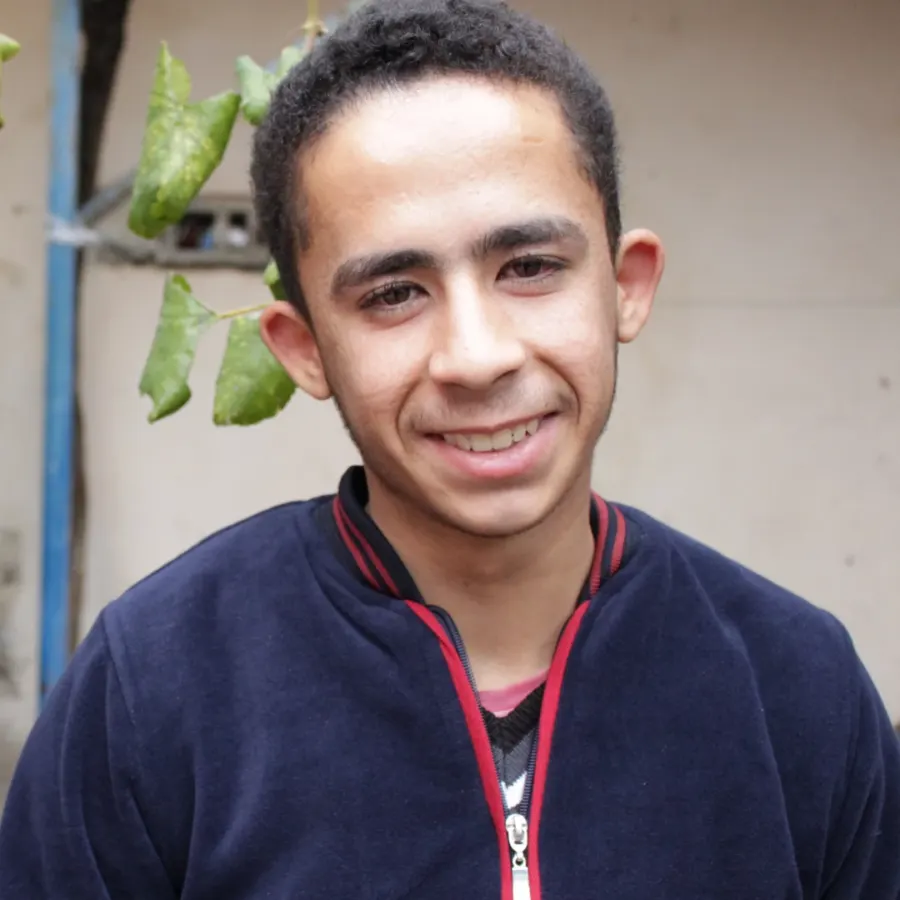
My name is Fawaz, and I am from Idlib, Syria. I was only ten years old when I left Syria with my parents and siblings. I will never forgive the war that took not just my home, but my father’s ability to hear and walk.
I am the oldest of my six siblings, so I grew up with the responsibility to help my mother around the house — taking care of my sisters and brothers — while my father walked the streets selling tissue boxes. Before my father’s physical treatment to help him walk again, my sister Nermin would go help him sell tissue boxes. None of us went to school around that time.
We joined Karam when the Karam Families team offered to help my father repair his hearing aid. It was difficult to communicate with him when he couldn’t hear us, so he was always frustrated.
Karam not only helped my father regain his hearing, they enrolled all of us in school. Studying has always been my top priority. I was fourteen when I went back to school, they put me in third grade because I had missed so much. Every day I was taking intensive classes to catch up with my classmates.
I worked hard and got good grades until I reached and finished eighth grade. Right as I was getting ready to register for high school, the school administration told us that there was no record of my grades — they had lost EVERYTHING. I was devastated.
My only other option was to enroll in The Accelerated Education Program (HEP), where students are taught courses in the Turkish language and basic math and science. The program is eight months long, but it took me two years to finish it.
After graduating from HEP, I had all of my records in Turkey and was finally able to enroll in a school of my choice. I decided to go to trade school for carpentry. At school, we learn for two days and work for 3. The school has a contract with multiple carpenters who take us in for hands-on experience.
If I could send a letter to the world, I would say: it is important to remain on the right path and not cause any trouble. Education is the most important thing in life, so always seek the knowledge you crave, no matter what it is.
More stories
Azari Hamdan
Here I am alive but I am not living
I lived in Syria for 16 years, I remember my neighborhood with all its details. Looking back, I lived a very happy life but I wasn’t aware of it. When one loses these blessings, it is when they realize that they had them.
I lived in Syria for 16 years, I remember my neighborhood with all its details. Looking back, I lived a very happy life but I wasn’t aware of it. When one loses these blessings, it is when they realize that they had them.
I used to always wish that I could leave Syria and go to another country. I would even nag my mom. Now I sometimes see jasmine on the street, and I remember the jasmine tree that we had at our house in Syria and how I used to be unaware of its beauty. Now that I’ve left, I’ve begun to remember even the smallest details. Before? I never did.
I came to Reyhanli, Turkey at the end of 2016. The journey from Syria to Turkey was a disaster. We left our hometown of Douma because of the siege and went to our grandparent’s house in Deir Ezzor. But then ISIS came there. When ISIS entered the city, the first thing they did was ban school attendance. Immediately after, my mom decided that it is best to leave for Turkey. As we were getting ready to leave, ISIS forbade traveling to “disbelieving countries.” So we stayed for another year before we paid a smuggler to take us from Deir Ezzor to Idlib. However, on our way there, ISIS captured us.
When ISIS found us, we were scared for our lives. They asked us where we are going and why. We told them we are going to Turkey. This is when they took my sister’s husband. We couldn’t predict what was going to happen, but they ended up separating men from women. They took us to a house in Aleppo, and we stayed there for a day until a group of women and men came in the middle of the night and opened our bags to search them, but they did not find anything. Then, they told us we could go.
We were afraid of getting captured, so we decided to go back to Deir Ezzor, but my sister’s husband refused. He said he will find us another smuggler. We did, and everything went smoothly. We reached Idlib and there were mountains everywhere. When we reached the Turkish border, there was another mountain to cross to reach the other side. I said it was impossible to do so. Then, it turned out to be very easy, especially compared to what other people have going through. On our way to the Turkish border, we met people who had said this was their fifth time trying to cross, but they kept getting sent back to Syria. That’s when I knew that this might happen to us as well.
We left Idlib at 5:00 AM and got to Turkey at 8:00 AM. The entire journey took us ten days. We were able to pass through without the Turks saying anything.
During the Journey, my main concern was my mother. She was 47 years old then and it was a hard trip. I lost my dad to a car accident 18 years ago when my mother was pregnant with me, so she was all on her own.
When we first arrived in Reyhanli, I never used to leave the house because of what we had to endure under ISIS rule in Deir Ezzor. I still remember hearing them slaughtering people right outside the house. One time I heard them kill a man who missed a prayer. I was impacted by this because some of the people who were killed were people I knew. When I came to Reyhanli, it was a whole different world, a world where people had no idea what was happening a few miles away in Syria. Here I am alive but I am not living. People in Syria are still being slaughtered, it’s happening now. I feel it, I still hear it. If I was in Syria now I wouldn’t be alive. It’s painful —I don’t even know how to describe it.
New Beginnings and New challenges
We had been living in Turkey for three months when my sister and I decided to register for a Turkish course. Unfortunately, there was only one spot left, so I gave it to my sister. She was in her Baccalaureate year, and it made more sense for her to take the class. Coincidentally, they opened up another course and it was free. However, my mom told me to wait but I did not want to so I registered. A few days into the Turkish class, I met Mr. Amir and Miss Hamsa from Karam House. They told us about the studios they offer and the Innovative Education program they have. It sounded interesting but I did not register because I hadn’t even considered it then.
When I started coming to Karam House, it had been my dream to study engineering, since I was little. But when I began working on projects at Karam’s Studios, I realized that I did not like engineering that much. I did not know what I wanted to do. But, my sister came to me and told me that our father, may he rest in peace, wanted one of us to become a doctor. All of my older sisters studied literature, and are now teachers, but I always had a tendency towards the sciences, so I decided to study medicine and make my father’s wish come true. It’s a humane and brave field. I am terrified of blood, but I also believe that when you are afraid of something, you have to go and do that same thing to break down the barriers.
I am a very shy person. I get nervous speaking in front of people. However, after joining Karam my personality changed a lot, I learned about responsibility, and I became more dependent on myself.
Refugees Helping Refugees
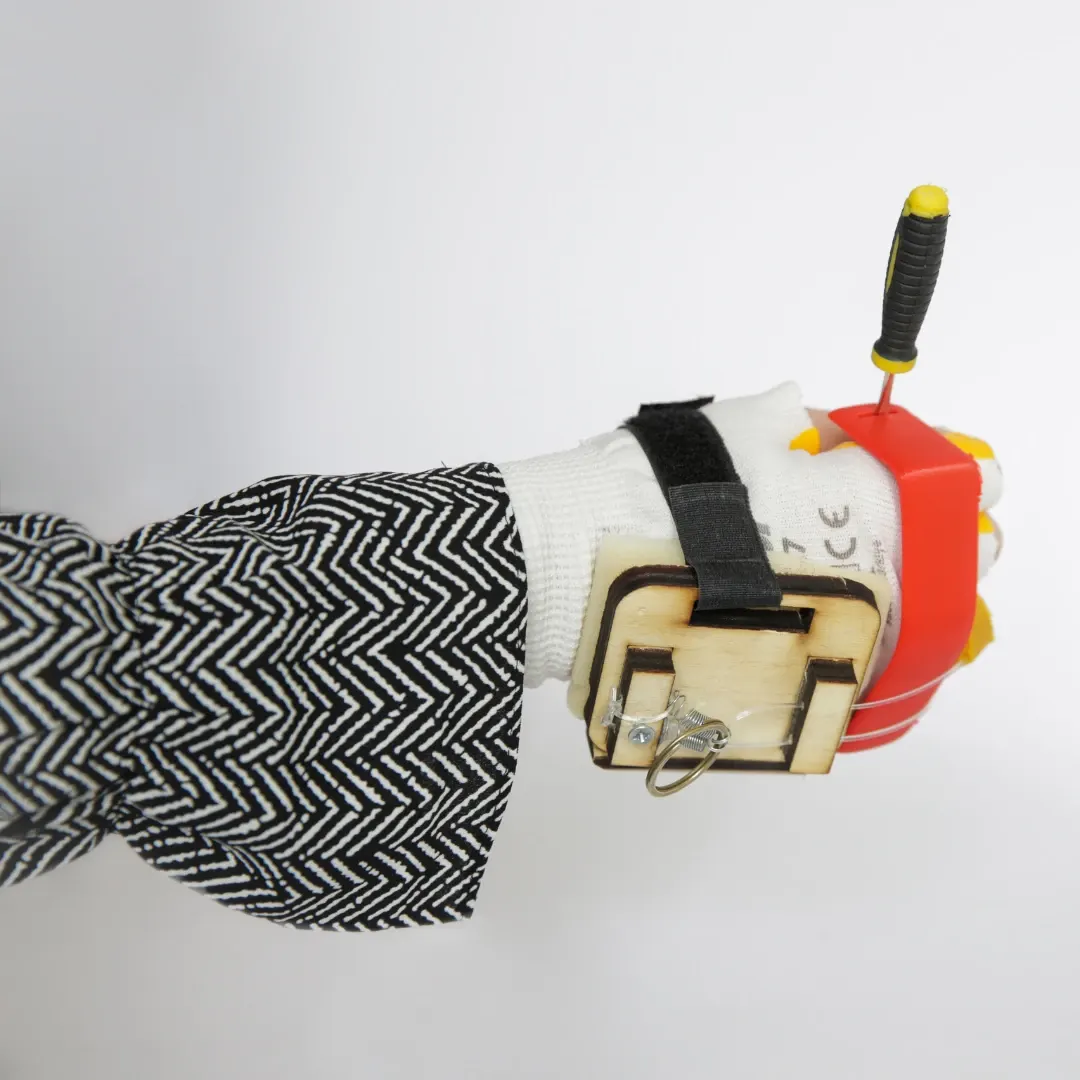
The first project I worked on was in a prosthetic workshop. We had consultants who were disabled and needed a prosthetic limb. The idea was to make a prosthetic that was innovative yet simple because prosthetic limbs are expensive. We wanted to make something complicated out of simple materials.
Coincidentally, the case they assigned to me, turned out to be someone from my city — from Douma — and I liked this. I was really happy when the mentors assigned Mohammed’s case to us. Yes, it’s true that we are all Syrian and that we are all one, but I feel that the people from Damascus understand me. They understand my customs, so I was excited to work on his case. But in the beginning, I hesitated. I felt like I was going to withdraw from the workshop. I didn’t think I could give them hope in something that may not turn out correct.
We were working on this project with our NuVu Partners in the United States. They worked on the same case but made a different prosthetic for Mohammed: they assigned them the left hand, and us the right hand. We met with them every week online, and we would see what they did and show what we had completed. We would do this every week, and show each other our progress.
The first time we went to the center to meet our consultant for the first time, I was shocked. When I met Mohamad, he spoke about his hand saying that it was in 2014, a fragment ricocheted into his head, and this fragment caused brain spasms. The result was a lack of movement in his left hand and partial movement in his right; he had limited movement in three of his fingers: ring, middle, and pinky.
As we got to know Mohamad, he said that his hobbies are writing, learning English and Turkish, and photography. So, our idea for his prosthetic came from the fact that we wanted his fingers to move. We began our research on the internet to find other projects and get inspiration, most of the projects we found had a mechanical aspect to them, and I am not good at mechanics. After a long time of researching, we knew that it would be impossible to make his hand move without electronics, he would need power or something similar to make it work. Therefore, we settled on the mechanical idea and began our learning and trying process. It took us 15 weeks of trying and re-trying, we did all that we could do and kept wondering; is it going to work or not?!
Final Results of the Project
The project ended up being an expression of the palm wearing a vest — the idea was that it would strengthen the three fingers on his right hand so that he could move them. If he wanted to hold something, he couldn’t. If they opened, he could hold things. The project consisted of three parts: the wrist, the hand, and the fingers.
We started by making a prototype from cardboard and then once we had everything set we Rhino Fusion, this was my first time working with Fusion. I learned quickly and was able to finish this project.
Before starting this workshop, I would wake up in the morning very sad, not knowing why. But now after I created this project, I wake up every day and thank God for my health, and for all the opportunities I had like going to school and joining Studios such as the Prosthetic workshop.
Once everything was set and ready, we used the 3D printer to print the project. It took us a few tries before we got the exact measurements needed. I felt so proud and satisfied with the final result.
I don’t want to say we’ve given him hope, but at least we tried. What is that phrase? I didn’t feel that we could have failed because, in the end, we tried. Even if we failed, there was honor in trying.
Abdullah Sammei
Triumphant Passage
My name is Abdullah Samie. I am originally from Idlib, Syria, and live in Reyhanli, Türkiye. I’ve been living here for approximately eight years.
My name is Abdullah Samie. I am originally from Idlib, Syria, and live in Reyhanli, Türkiye. I’ve been living here for approximately eight years.
I came to Türkiye with my uncles. Because of a difficult situation back home, my father had to come to Turkiye first. Shortly after, my uncles followed, and then my mother, my two sisters, and I made our way to Reyhanli.
I remember the journey vividly. We traveled from Idlib to Lattakia, which was particularly challenging because Idlib had become a military zone. At every checkpoint, we had to pay money to proceed. There were moments when we had to pretend to be asleep in the car as we crossed to avoid suspicion.
One incident sticks out in my memory. At a checkpoint zone, the soldiers questioned my mother about our whereabouts. When the soldiers noticed my aunt, who was only about 10 or 12 years old at the time, they asked her to get out of the car and said she couldn’t pass. The driver had to give them money to let us go. We finally got to Lattakia, where we left my aunt with our relatives and continued to Turkiye.
Our neighborhood in Idlib was called Al-Same. I have fond memories of playing with my friends in the area. There was a place with trucks we used to call the ferry where we would play for hours. Those were beautiful times filled with joy and freedom.
Now, I am in the final stages of my baccalaureate education. I’ve missed a year of school while migrating to Turkiye. I’ve always been interested in studying software engineering. Initially, I didn’t think much about it, but my interest grew as I saw how things worked.
I came across Karam House, a place that played a significant role in my life. Before joining Karam House, I learned a lot on my own. I took part in a computer basics course at my school and realized I needed more advanced knowledge.
Eventually, I registered at Karam House. The support and resources I found there were incredible. The discussions with mentors, brainstorming sessions, and collaborative projects were all invaluable experiences.
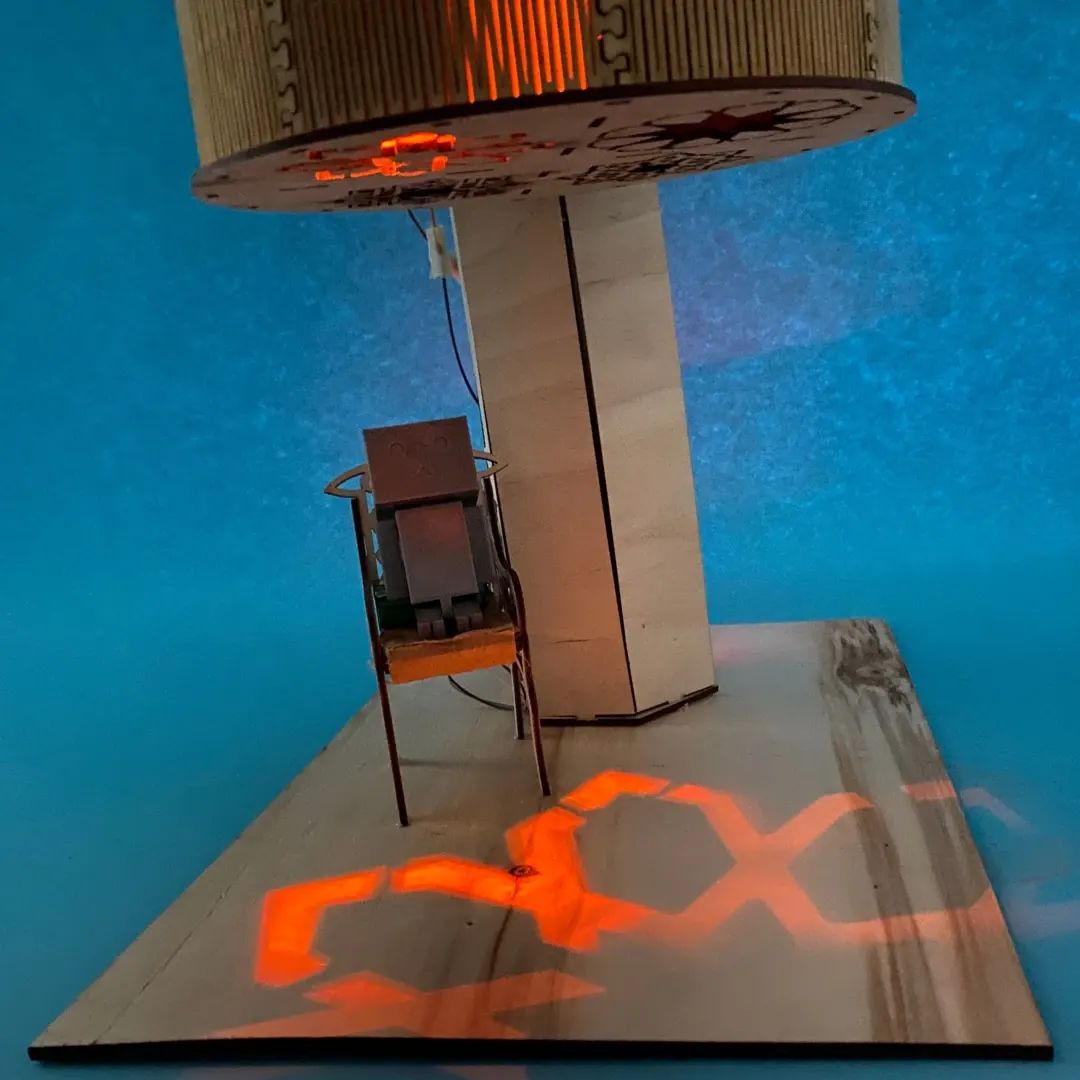
One of the projects I worked on at Karam House was “Tree of Knowledge.” The goal of this project was to introduce Islamic culture around the world through light and integration between societies. We started by sketching the lamp post and the mechanics behind how the light would work. Then, we made a prototype. After that, we designed it on Rhino, printed the pieces on a 3D printer, and assembled them together.
One of my favorite moments was presenting my project during final studio sessions. I remember seeing other presentations and feeling motivated to improve mine. This drive to excel and the sense of community at Karam House has truly changed my personality, boosting my self-confidence and mental clarity.
Graduating from Karam House felt like a significant achievement. I am grateful for the opportunity to volunteer there and continue sharing ideas and learning.