
Gofran Bozan

I loved it but had to leave

My name is Gofran Bozan. I am 16 years old, and I am from Homs, Syria.

We left Syria in 2014, but we didn’t face much trouble in coming to Turkey because we had passports with us, although the journey here was a bit scary because we had to go to Idlib before coming to Reyhanli. The best thing about Syria was our house.

When I left, I was young. I was only eleven years old, and I was upset, of course. We had lost my brother and father, so it was really hard to leave my home and come here with my mother and other brother. Now, though, I like living in Reyhanli because living here is like living in Syria. You don’t feel as though you’ve gotten so far from the place you used to live. And everyone here is Syrian, so you can talk with anyone.

When Karam House first opened, I heard about it online and wanted to attend, so I registered my name and came to a workshop. I loved it but had to leave. I was under a lot of stress because I was enrolled in a Turkish school, so I left everything and began to focus on learning the Turkish language. After nine months or so, my brother began working here and registered my name, so I began taking workshops again.

I like coming to Karam House because you feel as though it’s a different institution when compared to others. It develops our skills, and there are so many people that I love to come and see every week. I always say that I wish school was more like Karam House because I always feel motivated to keep coming to Karam House. The teaching is done in a different way that equips us with practical, useful skills that are ultimately beneficial, and the relationships between students and mentors are much better than they are with teachers at school. Here, you feel more comfortable around the mentors, and they prioritize your comprehension more.

The best project I created was a mini robot that mimicked a vacuum. The goal of the robot was to save time and help the elderly with cleaning. This robotics workshop, in addition to the photography workshop, has benefitted me the most. Robotics taught me how to program and the photography workshop taught me to focus more on details in pictures.

One of my favorite stories at Karam House involves the sixth project I worked on. I made a movie about losing one’s father, drawing on my own experience of losing my own father in Syria. It was about a three minute film and took place in the present, but I am remembering my childhood with my father. I recall all that he used to tell me and hope that he can see how I am now accomplishing my dreams. I had a little girl act as me and my older brother acted as my father. A lot of people attended, watched the film, and really liked it. I remember one person started yelling bravo because he was so happy with the film while others started crying because they were so moved. That moment really, really impacted me because I felt like people were happy with something that I made.

I would explain Karam House as a place to develop one’s skills. You feel as though it really is your house and that you can be comfortable here. You will accept people regardless of who they are and accept the thoughts of the person in front of you. Overall, you will learn a lot of new things. Even though I am shy, I always share my opinions with other people because I understand that my opinion can create an impact and that if I say something it may happen.

My hope for Syria is that it finds peace. I would love to return one day to visit my family one day because all of them are in Syria and because I am nostalgic. Ultimately, I hope that Syrians can return to the country and build it anew.
More stories

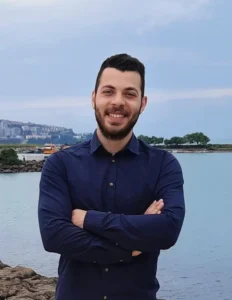
Mahmud Mardini, a Karam young leader

Mahmud Mardini

Thank you from the bottom of my heart

At age 15 Mahmud left Syria with his two older brothers, sister, and parents. They went in pursuit of safety and a better future, leaving behind everything they had already lost. Yemen was their first stop. His dad had worked at the Yemeni Embassy in Syria, so it was safe for them to enter the country. Shortly after their move to Yemen, his father passed away, leaving the family on their own to figure out how they could survive. They opened a restaurant and lost everything seven months later when the war in Yemen began.

At age 15 Mahmud left Syria with his two older brothers, sister, and parents. They went in pursuit of safety and a better future, leaving behind everything they had already lost. Yemen was their first stop. His dad had worked at the Yemeni Embassy in Syria, so it was safe for them to enter the country. Shortly after their move to Yemen, his father passed away, leaving the family on their own to figure out how they could survive. They opened a restaurant and lost everything seven months later when the war in Yemen began.

Their next stop was Turkey. They had nothing, having lost everything in both Syria and Yemen. Mahmud was still under 18 years old, so he went back to Syria with his mother in hopes that they could rebuild what they had lost, and that he could go back to school. The dream turned out to be just a dream. While in Syria, Mahmud was arrested twice, and their neighborhood was under attack and bombing. As more and more of his friend left, the stress of an unknown future caught up to him.

Education was important to Mahmud. He was determined to study, but it was hard for him because he had lost all of the papers to certify his previous school performance and status. His dream was to go study in Europe, so he worked hard and made it to Germany in 2016, where he got his residency papers and learned the language. While in Germany, he stayed with a German family who hosted him while he attended school. Things were tough there: Syrian refugees were – and are – faced with a lot of racism and discrimination, adding pressure on what he had already been through.

One day, the German family’s house started on fire. Mahmud had to go live somewhere else and ended up living with a friend of that same family.

The stress and loss took their toll and led him to have not one but two strokes, hospitalizing him at such a young age. They were his wake-up call — the sign that it was time to go be with his family. So he returned to Turkey in 2017.

That’s where everything began to change for the better. He learned the Turkish language. He then faced the Açık öğretim test with a 98%, granting him a high school diploma and the ability to enroll in the university.

He first got into the Management Information Systems Department, and a year later due to his high grades, he was able to transition to Computer Engineering and start fresh.

Despite being new to the country and one of three foreign students in this department, he became the educational coordinator of the innovation and software club. After five months of organizing events in engineering and coding, the president of the department asked him to be the president of the club.

The following year he was nominated to be the department representative in the university. He got his Turkish citizenship around that same time. Things were looking up for Mahmud.

When the world shut down from the Covid-19 pandemic, he was going to school online, taking online courses from American universities, and working as a freelance web developer for companies all around the world, such as Palestine, Turkey, and even the U.S.

In his final year of college, he joined a Bootcamp at Trendyol, the company he currently works at. Trendyol is the Turkish equivalent of Amazon, with branches all over the world. During that summer’s Bootcamp, only 40 out of 2,000 applicants were moved on to the next phase. Only 20 of them were hired. Mahmud was one of them.

He was both the first foreigner and Syrian to join the Trendyol team, and the first to have joined before graduating and without previous work experience. He worked hard for what he got.

Before Trendyol, Mahmud was a Karam Scholar, working hard towards his degree and the betterment of his community. He learned about the scholarship through an ad on social media. He was very careful and attentive to details while filling out his application. He was working in tourism, but it was taking a toll on his studies and grades. When he was accepted into the program, he was very happy because it helped him to focus on school.

He loves the Karam Scholarship, not only for the financial help, but for the social aspect of it, the constant communication, and the mentors always asking about and listening to the Scholars’ problems and difficulties.

When we asked Mahmud where he felt he belonged, he laughed and said, “This is a very difficult question to answer. Maybe there are two places I feel that I belong to, the first one is definitely Damascus where I was born, but because I’m an immigrant, I think the second place will be Canada, because Canada is a country full of immigrants.” Mahmud has neither lived in nor visited Canada. But the stories of  his friends who live there lead him to believe that he could feel at home there. He’s heard of how welcoming people are and about the large Syrian community.

Mahmud’s message to Karam is this: “Thank you from the bottom of my heart. I hope that you continue this path and give this opportunity to more Syrian youth because a lot of them are waiting for this opportunity.”

Taysir Alrahal, a Karam young leader

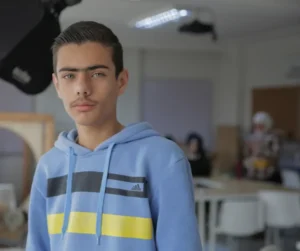
Taysir Alrahal

The mentors at Karam House are the best

We arrived in Reyhanli, Turkey in 2013. The journey from Syria to Turkey was a bit hard because I think we came illegally, but I was too young to know much about the details. I find Reyhanli to be nice, though. I like the people here, and I like the fact that they know Arabic and can understand us. It’s made Arabic enough of a language to get by—for now, at least.

We arrived in Reyhanli, Turkey in 2013. The journey from Syria to Turkey was a bit hard because I think we came illegally, but I was too young to know much about the details. I find Reyhanli to be nice, though. I like the people here, and I like the fact that they know Arabic and can understand us. It’s made Arabic enough of a language to get by—for now, at least.

I first heard about Karam House from my school friends who were registered here. One of them told me about it, and I immediately found out how I, too, can enroll and started to attend. Before coming to Karam House, I didn’t have any extracurriculars. I would just come and go from school to home.

Now, however, I’ve completed about six studios at Karam House. I recently took part in the Flying Robots workshop, and I like it because I’m interested in programming. In fact, I want to go to college and be a programming engineer.

Karam House helps me pursue this dream because I can develop my skills in this area in ways that I just can’t do at school or even on my own.

For instance, my favorite project that I’ve worked on while at Karam House is the drone that my partner Adil and I built. Even though it hasn’t flown yet, we’re so proud that we built a drone!

The mentors at Karam House are the best. They’re so great at explaining the ideas and concepts behind the workshop so that each student understands. They’re not quite like teachers, and I definitely don’t feel like I’m in school when I’m here. I feel much more creative here through the projects we are able to build.

To me, Karam House is a place that allows us to develop our skills, but it’s also just a really awesome space to be in. In my opinion, everyone should join Karam House!