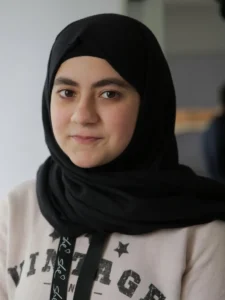
Mohamad Hasan, a Karam young leader

Mohamad Hasan

Opening Doors

When I was seven years old, my father was killed in an airstrike. I still remember the moment we heard the news—how my world changed forever. My father’s death forced me to grow up quickly. As the eldest, I became responsible for my family. We stayed in our home in Raqqa, Syria, even as the bombings intensified, holding onto hope that things would get better. Eventually, however, the destruction became too much, and we had no choice but to leave everything behind.

For three years, we moved from place to place inside Syria—from Raqqa to Deir ez-Zor, and finally to my mother’s village in rural Aleppo. Life was uncertain, and every day was a struggle. In 2021, my uncle in Turkiye suggested that we flee Syria altogether. My mother was reluctant; she didn’t want to leave her family behind. But we knew we needed safety and a future, so we made the difficult journey to Turkiye.

Starting over in Turkiye was harder than I imagined. We lived in a shelter for orphans where the rules were strict, and freedom felt like a distant memory. I couldn’t work, and I had to start my education from scratch because my school certificates from Syria weren’t recognized. It felt like I had lost everything—my home, my father, and even my sense of self.

But then, I found Karam House.

When I first heard about Karam House, I didn’t know what to expect. Friends told me it was a place where you could learn and work on projects, but I never imagined how transformative it would be. From the moment I walked in, I felt something I hadn’t felt in years: hope. Karam House wasn’t just a place to study; it was a place where I could dream again.

One of the studios that impacted me the most was “Emotive Gateways.” It was here that I worked on a project called Emotional Mechanism Doors, which became one of my favorite accomplishments. In this project, I designed doors that moved to represent different emotions like trust, attraction, or indifference. To bring these feelings to life, I carefully chose mechanisms like circular gears, linear gears, and half-circle gears to control the movement of the doors. Each design was crafted using Rhino software, through which I meticulously planned the motion to reflect the emotions I wanted to portray. After finalizing the design, the pieces were laser-cut, and I assembled the doors to create a tangible representation of these emotions. It was a deeply creative and technical process, and seeing the finished product gave me a sense of pride and fulfillment I hadn’t experienced before.

The workshops, the mentors, and the friends I made at Karam House helped me rebuild my confidence. I discovered skills I didn’t know I had—like designing apps, working with technology, and translating emotions into innovative designs. Every project I completed reminded me that I still had a future and that I could still create something meaningful.

Now, as I look ahead, my dreams are clearer. Education is my priority. My mother always says we’d rather go hungry than give up on learning. I want to continue growing, not just for myself but for my family. I want to be an example for my younger siblings and a source of pride for my mother.

Karam House gave me a second chance at believing and dreaming. Next year will be my last year in high school, and I plan to continue my education and go to college.

Karam House is a sanctuary, a place where young people like me can find their voice, their purpose, and their strength. I will always carry these lessons I learned here when I return to rebuild Syria. I belong to Syria and dream of returning when things are stable.
More stories

Abdullah Sammei, a Karam young leader

Abdullah Sammei

Triumphant Passage

My name is Abdullah Samie. I am originally from Idlib, Syria, and live in Reyhanli, Türkiye. I’ve been living here for approximately eight years.

My name is Abdullah Samie. I am originally from Idlib, Syria, and live in Reyhanli, Türkiye. I’ve been living here for approximately eight years.

I came to Türkiye with my uncles. Because of a difficult situation back home, my father had to come to Turkiye first.  Shortly after, my uncles followed, and then my mother, my two sisters, and I made our way to Reyhanli.

I remember the journey vividly. We traveled from Idlib to Lattakia, which was particularly challenging because Idlib had become a military zone. At every checkpoint, we had to pay money to proceed. There were moments when we had to pretend to be asleep in the car as we crossed to avoid suspicion.

One incident sticks out in my memory. At a checkpoint zone, the soldiers questioned my mother about our whereabouts. When the soldiers noticed my aunt, who was only about 10 or 12 years old at the time, they asked her to get out of the car and said she couldn’t pass. The driver had to give them money to let us go. We finally got to Lattakia, where we left my aunt with our relatives and continued to Turkiye.

Our neighborhood in Idlib was called Al-Same. I have fond memories of playing with my friends in the area. There was a place with trucks we used to call the ferry where we would play for hours. Those were beautiful times filled with joy and freedom.

Now, I am in the final stages of my baccalaureate education. I’ve missed a year of school while migrating to Turkiye. I’ve always been interested in studying software engineering. Initially, I didn’t think much about it, but my interest grew as I saw how things worked.

I came across Karam House, a place that played a significant role in my life. Before joining Karam House, I learned a lot on my own. I took part in a computer basics course at my school and realized I needed more advanced knowledge.

Eventually, I registered at Karam House. The support and resources I found there were incredible. The discussions with mentors, brainstorming sessions, and collaborative projects were all invaluable experiences.

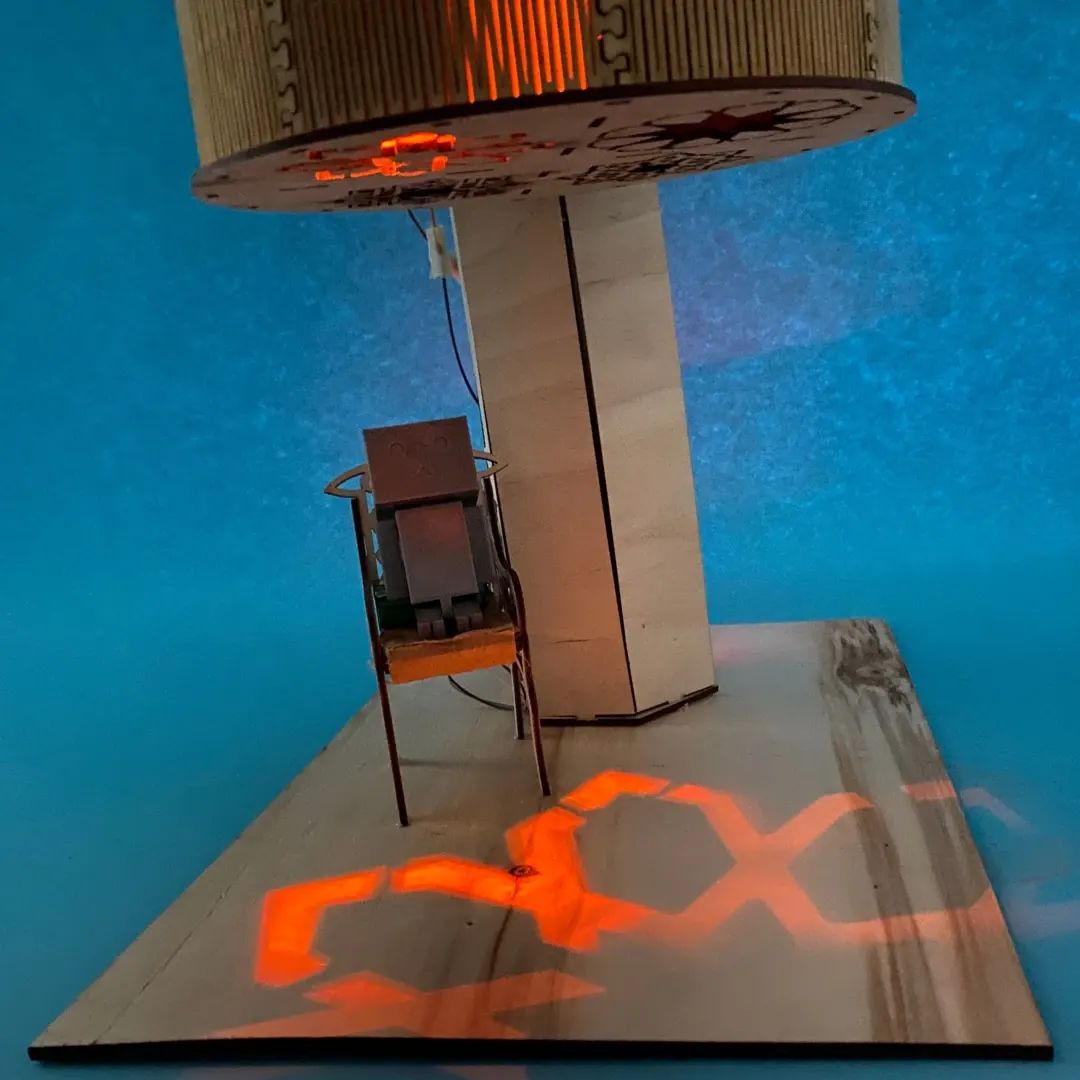
One of the projects I worked on at Karam House was “Tree of Knowledge.” The goal of this project was to introduce Islamic culture around the world through light and integration between societies. We started by sketching the lamp post and the mechanics behind how the light would work. Then, we made a prototype. After that, we designed it on Rhino, printed the pieces on a 3D printer, and assembled them together.

A light-up model made by Abdullah Sammei

One of my favorite moments was presenting my project during final studio sessions. I remember seeing other presentations and feeling motivated to improve mine. This drive to excel and the sense of community at Karam House has truly changed my personality, boosting my self-confidence and mental clarity.

Graduating from Karam House felt like a significant achievement. I am grateful for the opportunity to volunteer there and continue sharing ideas and learning.

Shahed Abdelsalam, a Karam young leader

Shahed Abdelsalam

It was snowing the day we came to Reyhanli

It was snowing the day we came to Reyhanli. Even though it was back in 2010, I remember it very well. As the flakes came down, my siblings and I rushed outside to play. We were enjoying the unusual weather, but our fun was cut short when our parents called us in. They told us we had to leave our village right away.

It was snowing the day we came to Reyhanli. Even though it was back in 2010, I remember it very well. As the flakes came down, my siblings and I rushed outside to play. We were enjoying the unusual weather, but our fun was cut short when our parents called us in. They told us we had to leave our village right away.

We were promised we’d only be gone for a short while and come back when conditions were better, but since crossing the Turkish border, we haven’t been able to return.

My uncle was the one who took us on the day-long journey. It was so sudden, so we didn’t have much packed. The trip was tiring, and the weather was extreme. I remember crying from the cold. We were smuggled across the border, and it was incredibly difficult. Once we made it, we stayed at our cousin’s house until we were able to get our own place.

I’ve lived half over half of my childhood in Reyhanli, but to be honest, it wasn’t that great a childhood. Be it the difficulty of acclimating or just the situation in general, it’s been pretty difficult. Two years ago, I transferred to a Turkish school, and being that I didn’t speak much Turkish, it was really hard. Honestly, I feel like I’m much different than other people because I really, really love our mother tongue, Arabic. I wish I get to speak it more.

The reality is that I sometimes feel like I’m starting to forget words in Arabic. Any word really, like pen or book. Instead, I say them in Turkish. Little by little, I feel like learning Turkish is beginning to impact my Arabic. I try to read more Arabic books and learn vocabulary. I spend my time reading Arabic poetry and diving deep into the language. This is the one resource that I have to hang onto my language.

I joined Karam House around 2018, and it honestly has been the best time of my life. I look forward to the weekend so that I can finally go back to Karam House and take part in the studios and continue working on my projects.

The most unique project I worked on was in the Cyborgs studio. We had to make a sort of mask that fits on the face, and it has an eye/contact that you can switch out. I got the idea from a cartoon called The Titans. One of the character’s names was Cyborg, and he used to have a tool for his eye that would spark and release fire. It was a really hard project because you have to think about where you’re going to find the eye, how the eye is going to move, what the project is going to look like, but in the end, it worked out perfectly.

Karam House is a place you wouldn’t find anywhere else.

This place helps students figure out who they want to be in the future because the workshops expose us to such a variety of skills and possible life paths. The best thing about Karam House, though, is the way we are treated. You’re not average here. Instead, you get to be someone great. You meet a lot of role models here, too. Every mentor is a role model to me, and the people are so unique and special. When I graduate from here, it’s going to be really hard for me.

In the future, I want to be a psychologist. I feel that people with psychological issues face a lot of injustice in our society, and nobody wants to sit and speak with them. I’ve already started researching mental illnesses little by little and learning more about them.

When I think of Syria, I think of Eid and Ramadan. Although I was small, I remember how amazing these times were. I try to recall events and remind myself of what it was like so that I don’t forget. My ultimate hope for the future of Syria is for the war to be over and to return. It won’t be the Syria I know — the streets, the buildings, the cars, the traffic won’t be the same. It will, however, be the land that is called Syria, and that’s what’s important.