
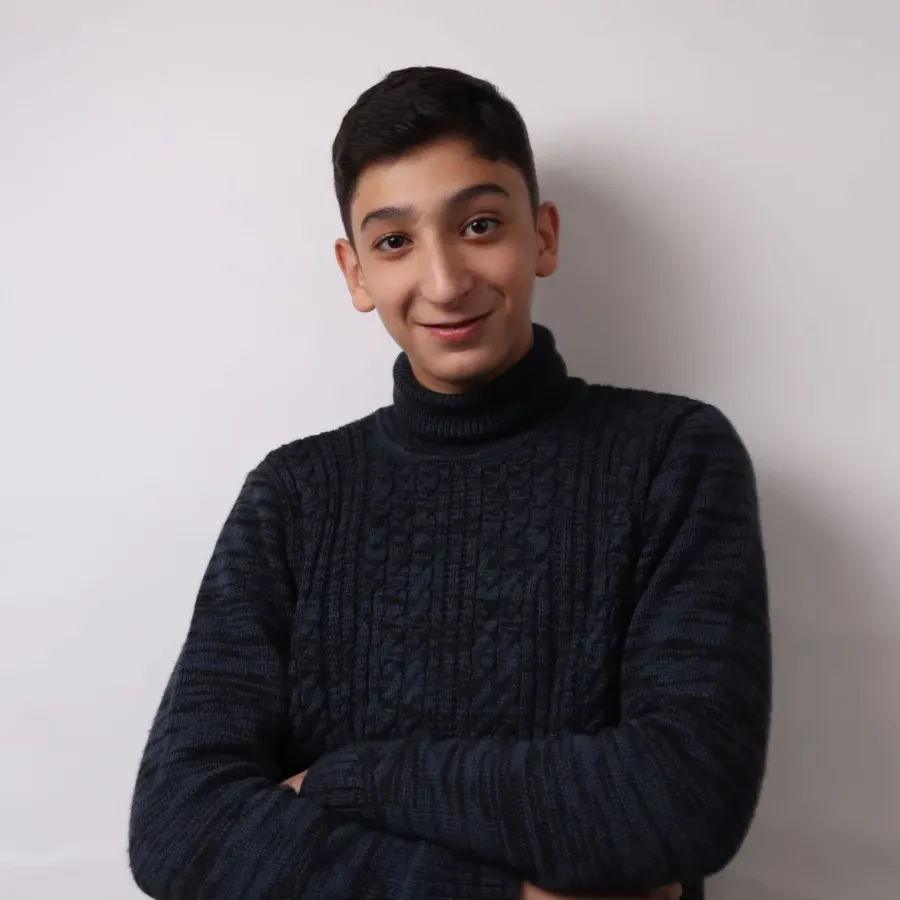
Wael Ajlouni, a Karam young leader

Wael Ajlouni

Do not hide your creativity: Draw, Write, Search

In an effort to fit into the new society that they now must call home, many refugees take extra steps to prove themselves to the natives of the adopted country. They start by mastering the language, engaging with the community, and focus on giving back.

Wael Ajlouni left his hometown in Damascus and came to Istanbul, Turkey, with a goal in mind to improve himself and give back to the place that welcomed him and his family.

With difficulties making connections and not knowing many people, Wael found it hard to engage, until he learned about and joined Karam. Immediately after joining the studios, Wael’s creativity and love for his community was evident in his work.

In a studio, Reimagining The Classroom, the students—including Wael— were asked to design and fabricate interactive objects that provide new ways of school-based communication, especially after going virtual and being entirely online . These ways should be designed to help students and teachers understand one another and effectively act according to each problem they face in a fun and innovative way.

In his description of his own project, Performance Management, Wael said: “Each child is talented in their own unique way. The key to discovering that talent is education. However, sometimes education doesn’t allow students to realize their talents. One of these things that could stand in the way of discovering themselves is distant learning. Therefore, it is important to spread awareness about the importance of education, and the importance of discovering oneself and their talents.”

His goals for the project are spreading awareness of the importance of discovering one’s talent and working to grow it, increasing confidence in regards to that talent, and bringing out the creativity that lives within students, no matter what field they are interested in, whether it is scientific, literature, or artistic.

The first step of the studio is researching and then conducting an interview with a teacher before implementing the project. Therefore, Wael chose one of his teachers and interviewed them. However, the teacher did not like the idea of the project and rejected it.

The rejection Wael received from the teacher did not stop him from pursuing his project. If anything, he was more determined to finish the project and show the impact it could have on the students.

After the final version of the project was finished, Wael took it to his class and showed it to his teacher. They were impressed by the outcome and even decided to implement the project in their classroom.

Now, the project is going to be placed in the school hallway where all the students can see it and interact with it.

The project is divided into an upper area, which is intended to encourage students to participate in different activities to discover their talent through phrases describing its use.

The phrases include:
Do not hide your creativity: Draw, Write, Search. 

Draw and don’t worry about the results. 

Write and live somewhere else.

Research and understand your own world. 

Don’t be afraid of the results if you never try. 

Don’t stop, the future is still ahead. 
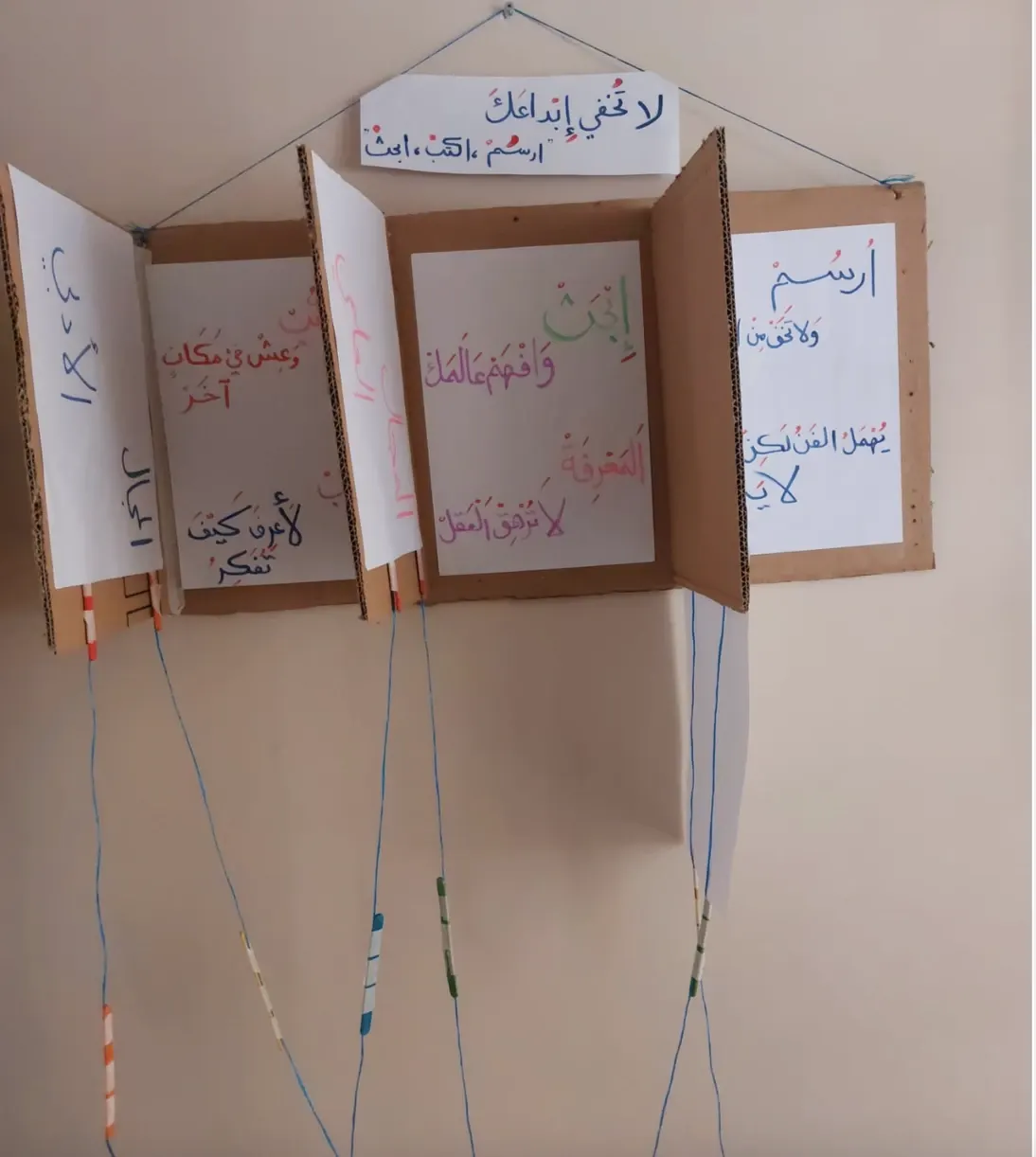
The main upper area is followed by three separate sections, with two hanging strings on which the students’ answers will be hung.

To Wael, this project will always remind him that when we have an idea, we must not give up and continue until the end to achieve it, or implement it. When we want to present an idea, we must prepare for it well, because an insufficient explanation or wrong details may be a reason for rejection.
More stories

Fawaz Shardoop, a Karam young leader

Fawaz Shardoop

Studying has always been my top priority

My name is Fawaz, and I am from Idlib, Syria. I was only ten years old when I left Syria with my parents and  siblings. I will never forgive the war that took not just my home, but my father’s ability to hear and walk.

My name is Fawaz, and I am from Idlib, Syria. I was only ten years old when I left Syria with my parents and  siblings. I will never forgive the war that took not just my home, but my father’s ability to hear and walk.

I am the oldest of my six siblings, so I grew up with the responsibility to help my mother around the house — taking care of my sisters and brothers — while my father walked the streets selling tissue boxes. Before my father’s physical treatment to help him walk again, my sister Nermin would go help him sell tissue boxes. None of us went to school around that time.

We joined Karam when the Karam Families team offered to help my father repair his hearing aid. It was difficult to communicate with him when he couldn’t hear us, so he was always frustrated.

Karam not only helped my father regain his hearing, they enrolled all of us in school. Studying has always been my top priority. I was fourteen when I went back to school, they put me in third grade because I had missed so much. Every day I was taking intensive classes to catch up with my classmates.

I worked hard and got good grades until I reached and finished eighth grade. Right as I was getting ready to register for high school, the school administration told us that there was no record of my grades — they had lost EVERYTHING. I was devastated.

My only other option was to enroll in The Accelerated Education Program (HEP), where students are taught courses in the Turkish language and basic math and science. The program is eight months long, but it took me two years to finish it.

After graduating from HEP, I had all of my records in Turkey and was finally able to enroll in a school of my choice. I decided to go to trade school for carpentry. At school, we learn for two days and work for 3. The school has a contract with multiple carpenters who take us in for hands-on experience.

If I could send a letter to the world, I would say: it is important to remain on the right path and not cause any trouble. Education is the most important thing in life, so always seek the knowledge you crave, no matter what it is.

Maram Karazoun, a Karam young leader

Maram Karazoun

From Quiet Dreams to Bold Realities

When I first saw a post about Karam House on Instagram, I was sitting in my room, scrolling mindlessly, not expecting to find the very thing that would change my life. But there it was— a post showing kids building robots, laughing together, and having a good time. I paused, stared at the screen, and felt something I hadn’t felt in a long time: hope.

When I first saw a post about Karam House on Instagram, I was sitting in my room, scrolling mindlessly, not expecting to find the very thing that would change my life. But there it was— a post showing kids building robots, laughing together, and having a good time. I paused, stared at the screen, and felt something I hadn’t felt in a long time: hope.

I didn’t think I’d actually be able to join in. Opportunities like this always felt so far out of reach for someone like me. But I clicked the link, filled out the application, and told myself, Why not? To my surprise, a few weeks later, I got the email: I was in! My friends Bara’a, Hiba, and I had all been given the chance to be part of something extraordinary.

Walking into Karam House for the first time was like stepping into a completely different world. The space was alive with creativity, laughter, and collaboration. I was directed to join the Social Robots group. I walked over, excited but nervous all at once. My hands trembled as I introduced myself to my team.

Before Karam House, I would have avoided group projects entirely, staying quiet in the back of the room. But here, something was different. Right as I said hello, the others shifted to make space for me, their faces open and inviting. Someone asked for my thoughts, and though my heart pounded, I hesitantly shared an idea. They nodded, encouraging me to keep going.

As we started building the robot together, I found myself speaking up more, laughing along with the group when things didn’t go as planned. For the first time, I didn’t feel like I had to be perfect to fit in—I just had to show up.

Through studios about programming and photography, I learned about my interests and what I’m passionate about. I’d heard of programming before but never thought it would be something I’d enjoy. I got the chance to try it out, and I realized it’s something I could see myself doing in the future. Now, I’m considering studying programming at university—something I never thought was possible.

Karam House didn’t just teach me new skills; it taught me that failure isn’t the end—it’s just another step in the journey. When an idea didn’t work in studios, the mentors encouraged me to try again, to look for another way forward. They helped me see that challenges are opportunities in disguise, and that mindset has transformed everything for me.

When I think about the person I was before Karam House and the person I am today, the difference is staggering. I’ve gone from being shy and unsure to confident and hopeful. I’ve learned to speak my mind, embrace my ideas, and dream boldly about the future.

Looking back as a graduate, I feel a deep gratitude for Karam House. It’s so much more than a space—it’s a home where young people like me can transform fear into courage, hesitation into determination, and dreams into reality.

And now, with everything I’ve learned and experienced, I’m ready to face whatever comes next.