


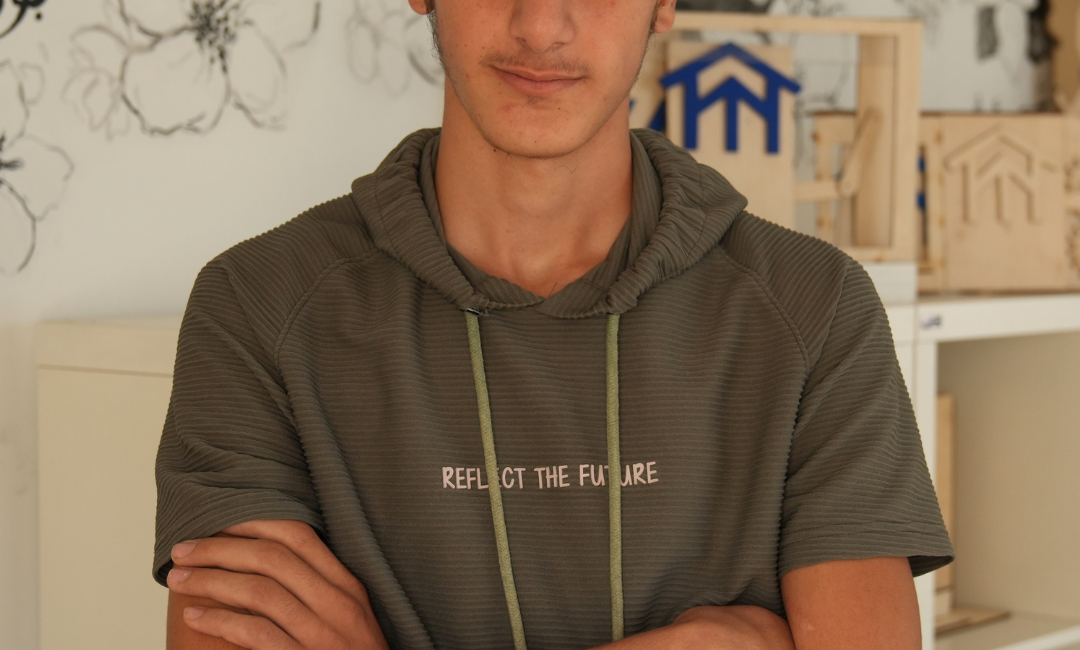
When I was ten, my world collapsed—literally. My father was out with friends in Damascus when an airstrike hit. The blast sent a wall crashing down on them. He didn’t survive.
I didn’t fully grasp what had happened, only that my life split into a ‘before’ and an ‘after.’ The ‘before’ was my home, my father’s voice, the steady rhythm of childhood. The ‘after’ was leaving it all behind.
From Damascus, we moved to Idlib, then to a camp in Atmeh in Northern Syria, before finally crossing into Turkiye. My mother grieved. I tried not to. As the eldest son, I had to be strong, but there were moments when the weight of it all pressed down like that collapsing wall in Damascus.
For a long time, I thought of survival as the end goal. Get through today. Figure out tomorrow when it comes. But then, something shifted.
It started with a question: What if I could build something instead of just making it through?
I had always been fascinated by computers, though most of what I knew came from watching YouTube videos on borrowed screens. I had tried coding on my own, but without guidance, it felt like trying to build a bridge without knowing where the first plank should go. Then I heard about a place where kids were learning programming, robotics, and design. A space filled with tools I had only seen in videos—fast computers, laser cutters, 3D printers. It sounded unreal.
When I walked into Karam House for the first time, I wasn’t sure what to expect. But I remember this: the air buzzed with ideas. The people inside weren’t just waiting for life to happen to them—they were creating it, and I wanted in.
At first, the programming courses intimidated me. Python. Typhoon. Loops and variables that didn’t make sense—until suddenly, they did. I wasn’t just learning how to code; I was learning how to think differently. My team and I built Cosmic, a game where I programmed the players, obstacles, and mechanics. I could see my ideas come to life on a screen, and for the first time in years, I felt like I was moving forward, not just holding on.
But Karam House wasn’t just about learning a skill. One day, I watched someone working on a laser cutter and stood back, curious. Instead of ignoring me, they asked, “Want to try?” That was the kind of place it was—where every curiosity had room to grow, where no one treated you like a refugee first.
Now, as I prepare for graduation, I see the road ahead differently. I’m not just the boy who survived a war. I am a programmer. A builder. Someone who can create instead of just endure.
To those who make spaces like this possible: You’re not just keeping the lights on. You’re sparking something that lasts far beyond these walls.
My name is Yasser Khoudani. I am not just a refugee—I am a creator, programmer, and a dreamer. And you know what? This is only the beginning.
